
Industrial nitrogen can be supplied in cylinders, racks, tanks or through direct on-site production. Each option involves different costs and technical requirements, which should be compared based on actual consumption and the company’s infrastructure.
Dictator, a Barcelona-based company specialising in lifting solutions and door systems, decided to review its nitrogen supply for its laser cutting equipment.
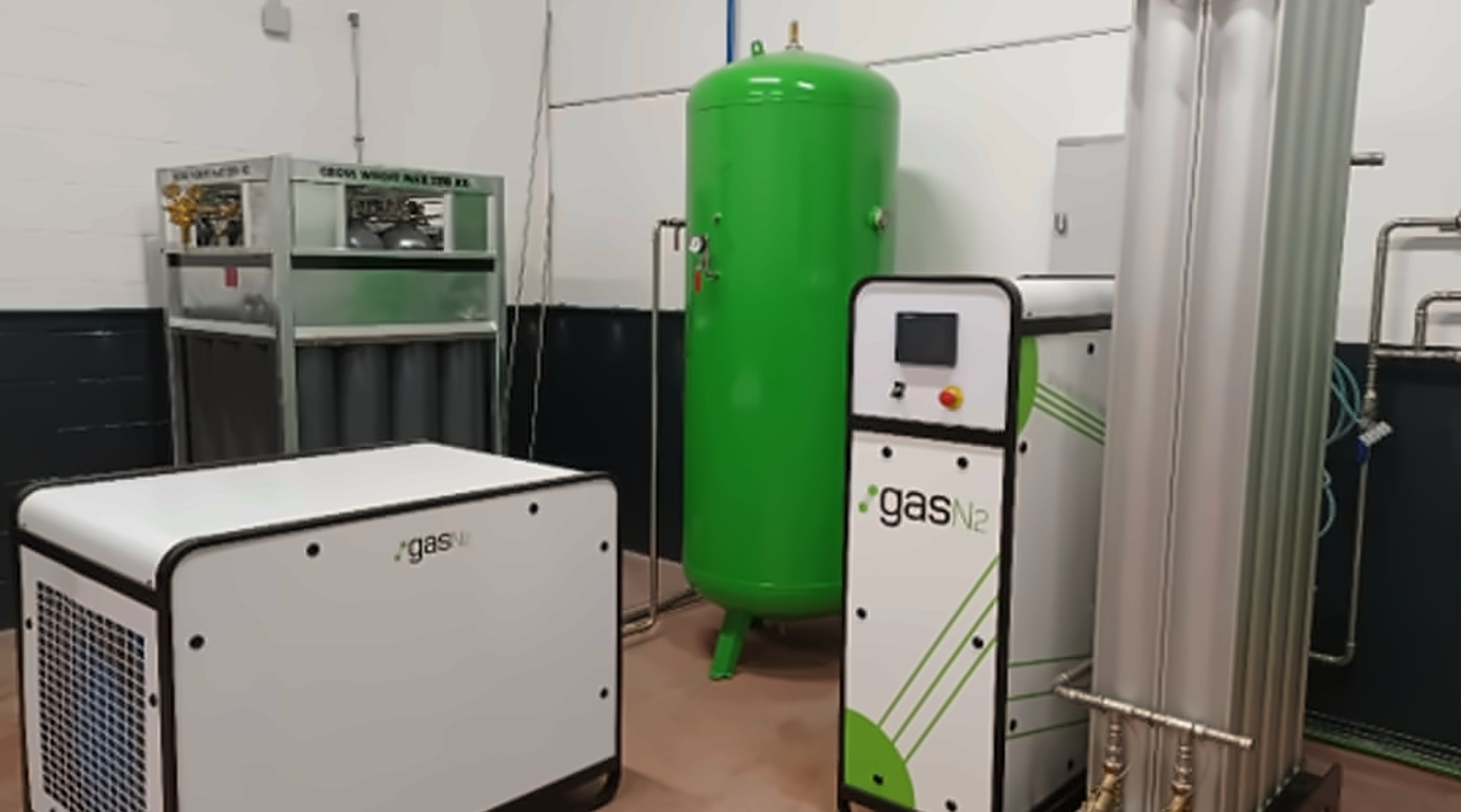
The company relied on an external nitrogen supply, stored in a centralised tank, and wanted to reduce logistics costs, improve productivity and simplify procurement. With GasN2, it implemented a GN27 HP high-pressure on-site nitrogen generation system.
The goal: optimising the supply model
The previous installation ran on nitrogen supplied from outside. The tank required three tanker truck deliveries a month, which generated around 3,600 kg of CO₂ a year and affected productivity.
An analysis of the cost of external nitrogen supply should include not only the price of the product, but also transport and replenishment logistics.
The technological solution: GN27 HP nitrogen generator
GasN2 installed a GN27 HP capable of producing nitrogen directly at the plant, with a capacity of 24 Nm³/h, a purity of 99.995% and a recompression stage up to 300 bar.
Instead of relying solely on external nitrogen supply, the plant now has a gas production infrastructure that obtains nitrogen from the air.
Generation, recompression and monitoring
The system separates nitrogen from pre-treated air and then recompresses it to meet the requirements of the high-pressure network.
The solution features continuous 24/7 operation, modular architecture, remote control, a digital display and traceability. These features make it possible to monitor the equipment’s parameters and make it easier to integrate into industrial management.
Benefits: cost savings and lower logistics costs
With the transition to on-site generation, Dictator can reduce or eliminate the costs associated with the previous external supply, such as regular tanker truck deliveries and their logistics costs.
On-site production delivers cost savings and reduces logistics costs.
Environmental impact of logistics
In the previous model, transporting nitrogen generated around 3,600 kg of CO₂ a year. On-site production reduces the CO₂ emissions associated with transporting the gas.
When does it make sense to replace external nitrogen supply with on-site generation?
Dictator’s experience is useful for companies with recurring nitrogen consumption that want to compare alternatives to external supply. Feasibility depends on annual volume, required purity, pressure, hourly profile, energy cost and storage expenses.
It is also important to consider the need for buffer storage, reliability and the backup options each process requires. Our article on how to correctly size a nitrogen generation system analyses these factors.
To learn about related projects, see the directory of GasN2 success stories and our nitrogen generators page. If you would like to study replacing your current nitrogen supply, contact the GasN2 technical team.