
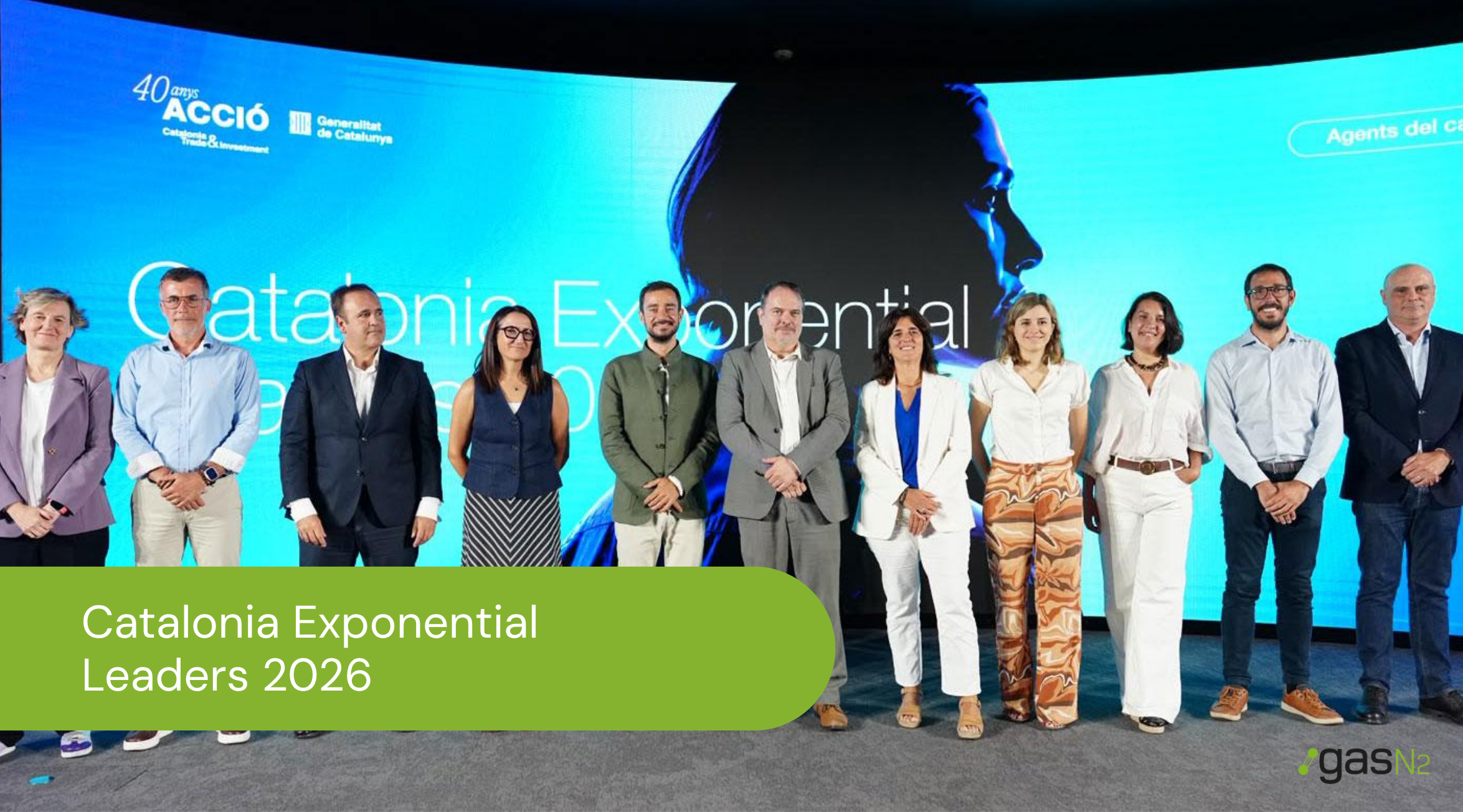
We have been selected as one of the ten Catalonia Exponential Leaders 2026, an initiative promoted by ACCIÓ that identifies Catalan companies with the most disruptive and distinctive projects and the greatest potential to transform their industries.
The selection was announced as part of the presentation of the Exponential Leaders in Catalonia 2026 report and was communicated through the official channels of the Government of Catalonia, ACCIÓ and EmpresaCAT.
This recognition highlights the work we carry out in the field of industrial decarbonisation and, in particular, our high-temperature heat pumps, a technology designed to reduce dependence on fossil fuels and electrify industrial thermal processes.
For us, being part of the Catalonia Exponential Leaders 2026 represents recognition of a track record based on applied innovation, energy efficiency and the development of solutions that contribute to a more competitive and sustainable industry.
What are the Catalonia Exponential Leaders?
Catalonia Exponential Leaders is an initiative promoted by ACCIÓ, the Catalan Government’s agency for business competitiveness, which identifies companies capable of transforming markets, processes and business models through innovative projects.
The programme focuses on companies that do not simply adapt to change, but develop solutions capable of anticipating it and generating a positive impact on the economy and society.
In this sixth edition, 175 business projects were submitted. Of these, 30 were selected as finalists and, ultimately, ten companies were recognised as Catalonia Exponential Leaders 2026.
The assessment criteria include the distinctive nature of the proposal, the incorporation of advanced technologies, the organisation’s innovation culture, its growth potential and its capacity to generate a positive impact.
The recognition does not focus solely on a specific technology. It also assesses the ability to turn innovation into a viable, scalable solution that can be applied to real-world challenges.
Being part of this selection places us among the companies helping to define new technological responses for the future of industry.
Why were we selected?
Our selection is linked to the development of technologies aimed at decarbonising industrial processes.
One of the main pillars of this proposal is our high-temperature heat pumps, designed to produce process heat using electricity and by harnessing waste energy available within the facilities themselves.
Unlike conventional boilers, these systems do not generate heat through combustion. They recover energy from an available thermal source and raise its temperature to the level required by the production process.
This approach makes it possible to address several industrial objectives simultaneously:
- Electrify thermal processes that have traditionally depended on natural gas.
- Recover waste heat that would otherwise be dissipated.
- Reduce direct CO₂ emissions associated with combustion.
- Improve the facility’s overall energy performance.
- Reduce dependence on fossil fuels.
- Progress towards decarbonisation targets without compromising production continuity.
Our heat pumps use natural refrigerants, generate no direct CO₂ emissions during operation and can achieve energy efficiency approximately three times higher than that of a gas boiler.
This combination of electrification, energy recovery and high efficiency enables progress towards more sustainable processes while maintaining essential aspects for any industrial facility, such as stability, control, reliability and economic viability.
High-temperature heat pumps for industrial electrification
Heat generation accounts for a significant proportion of the energy consumption and emissions of many industrial sectors.
Processes such as water heating, drying, pasteurisation, concentration, cleaning and steam production still depend, in many cases, on fossil-fuel-based systems.
Industrial heat pumps offer an alternative based on making use of energy that is already available.
They operate by recovering heat from a low- or medium-temperature source—such as air, water, refrigeration circuits or other waste heat streams—and raising it to a temperature that can be used by the process.
This technology is particularly valuable in facilities with simultaneous heating and cooling demands. In these cases, the energy extracted during refrigeration can be recovered and reused in another stage of the process, improving the facility’s overall efficiency.
We develop heat pumps capable of reaching high temperatures, expanding the number of industrial applications that can be electrified and facilitating the gradual replacement of combustion-based technologies.
This development is necessary because the industrial energy transition does not depend solely on generating renewable electricity. It also requires transforming the way in which heat is produced, recovered and managed.
A response to the main energy challenges facing industry
This recognition comes at a time when industrial companies must make progress in several areas simultaneously.
Emissions reduction coincides with the need to control energy costs, maintain productivity, adapt to new environmental requirements and strengthen the resilience of industrial facilities.
In this context, electrification, energy efficiency, emissions reduction and applied innovation are four closely interconnected areas.
Electrification of thermal processes
Electrification makes it possible to replace fossil-fuel-based systems with technologies that can operate using renewable electricity.
One of the main challenges is extending electrification to processes that require high temperatures or a stable and continuous thermal supply.
High-temperature heat pumps help overcome this barrier and make it possible to consider alternatives to gas boilers for a growing number of industrial applications.
Energy efficiency
Decarbonisation is not simply a matter of replacing one energy source with another. It also involves reducing the amount of energy required to achieve the same production output.
Waste heat recovery, the integration of heating and cooling processes and adapting equipment operation to actual demand make it possible to use the resources already available within the facility more effectively.
This improvement in efficiency can help both to reduce emissions and control operating costs.
Emissions reduction
By eliminating direct combustion, heat pumps reduce the CO₂ emissions generated within the facility.
The overall impact will also depend on the source of the electricity used. When the system operates using renewable electricity, the potential reduction in its carbon footprint is even greater.
Innovation applied to each process
A technology only generates real industrial impact when it can be reliably integrated into the specific operating conditions of each facility.
Temperatures, capacities, operating schedules, waste heat sources and production requirements vary from one facility to another.
For this reason, innovation must be supported by engineering, process knowledge and adaptability. This applied approach forms part of the way we develop each project.
An integrated approach to industrial decarbonisation
Although high-temperature heat pumps play a central role in this recognition, they form part of a broader approach to decarbonisation.
We also work on solutions related to on-site industrial gas generation, high-efficiency refrigeration, energy recovery, CO₂ capture and reuse and equipment digitalisation.
This combination of technologies enables us to address the energy performance of industrial facilities from a comprehensive perspective.
A single facility may have simultaneous requirements for cooling, heating and industrial gases, as well as waste energy streams or emissions that can be recovered, reused or valorised.
Analysing these elements together makes it possible to identify synergies between processes. Heat extracted during one operation can be used in another; gases can be generated directly at the point of use; and equipment can be monitored to adapt its operation to actual demand.
This integration facilitates the development of systems that are more efficient, controllable and tailored to the specific requirements of each industry.
What does this recognition mean for us?
Being named one of the Catalonia Exponential Leaders 2026 strengthens our position as a technology company specialising in solutions for industrial decarbonisation and the energy transition.
This recognition highlights our ability to turn research and technological development into solutions that can be applied to the real challenges faced by industrial facilities.
It also recognises an approach to innovation focused on delivering tangible results:
- Reducing fossil fuel consumption.
- Recovering and using waste energy.
- Electrifying industrial processes.
- Reducing direct emissions.
- Improving energy efficiency.
- Maintaining the reliability and competitiveness of production processes.
For our customers, this distinction reinforces our commitment to developing proprietary technology, continuous innovation and providing technical support throughout every stage of a decarbonisation project.
Continuing towards a more efficient and sustainable industry
The industrial energy transition will require combining different technologies and adapting them to the characteristics of each process.
There is no single solution that is suitable for every facility. Each project requires an assessment of heating and cooling demands, operating temperatures, waste energy sources, production schedules and emissions reduction targets.
Our selection as a Catalonia Exponential Leader 2026 recognises precisely our ability to turn this technical expertise into real industrial solutions.
We will continue working to help companies reduce fossil fuel consumption, recover energy, electrify processes and move towards a more efficient, competitive and sustainable industry.
If you would like to assess the opportunities for electrification, heat recovery or emissions reduction at your facility, contact our team. We will analyse the requirements of your process to define the most appropriate solution.