
Carbon dioxide is an essential raw material for many industrial processes. In the food sector, it is used in applications such as protective atmosphere packaging, beverage carbonation and certain processes in the meat industry. When CO₂ is a direct part of the process, continuity of supply becomes a key operational variable.
This winter, Europe’s energy context is once again putting this issue in focus. Fluctuations in natural gas prices directly affect the competitiveness of ammonia production and, indirectly, the availability of part of the commercial CO₂ supply. CO₂ availability may become constrained this winter, making it particularly important to review supply resilience and identify options that increase autonomy.
For plants that consume CO₂ on a recurring basis, the strategic question is clear: how can exposure to external fluctuations be reduced without compromising quality, safety or production continuity?
Why can the price of gas affect CO₂ availability?
Commercial CO₂ partly depends on ammonia production
A significant share of the commercial CO₂ used by industry is obtained as a by-product of ammonia production.
This relationship matters because producing ammonia requires high natural gas consumption. When gas prices rise, ammonia production in Europe becomes less competitive and some plants may reduce or halt output. When ammonia production falls, the availability of CO₂ obtained as a by-product also decreases.
A market sensitive to energy and logistics
Events in 2021 and 2022 already showed that a reduction in ammonia production can directly affect CO₂ availability. The UK food industry, for example, experienced significant CO₂ supply pressure after fertilizer plants shut down, while Europe’s energy crisis forced many ammonia producers to cut capacity.
The precedent is clear: in 2021, 60% of the UK’s food-grade CO₂ temporarily disappeared from the market after two ammonia plants shut down. In 2022, up to 70% of European ammonia production capacity was shut down due to high gas prices. In September 2026, gas prices again reached levels that put the competitiveness of this production under pressure.
This September, higher natural gas prices once again put ammonia production under pressure and, with it, commercial CO₂ availability.
What does supply pressure mean for an industrial plant?
Processes where CO₂ is critical
The impact depends on the sector and application. In food production, CO₂ can be part of the gas mixtures used in protective atmosphere packaging to help preserve the product, limit certain oxidation processes and maintain its properties. It is also commonly used in the beverage industry and in certain meat-processing operations.
When CO₂ is essential to the process, a supply shortage can bring the production line to a halt. For this reason, supply security should not be viewed only as a procurement issue: it is part of the plant’s operational planning.
From logistics dependence to a resilience strategy
A robust strategy combines forecasting, knowledge of actual consumption and diversification of available options. The objective is to reduce dependence on external CO₂ supply and gain greater control over a resource that is critical to production.
Capture and reuse CO₂: turn an emission into a resource
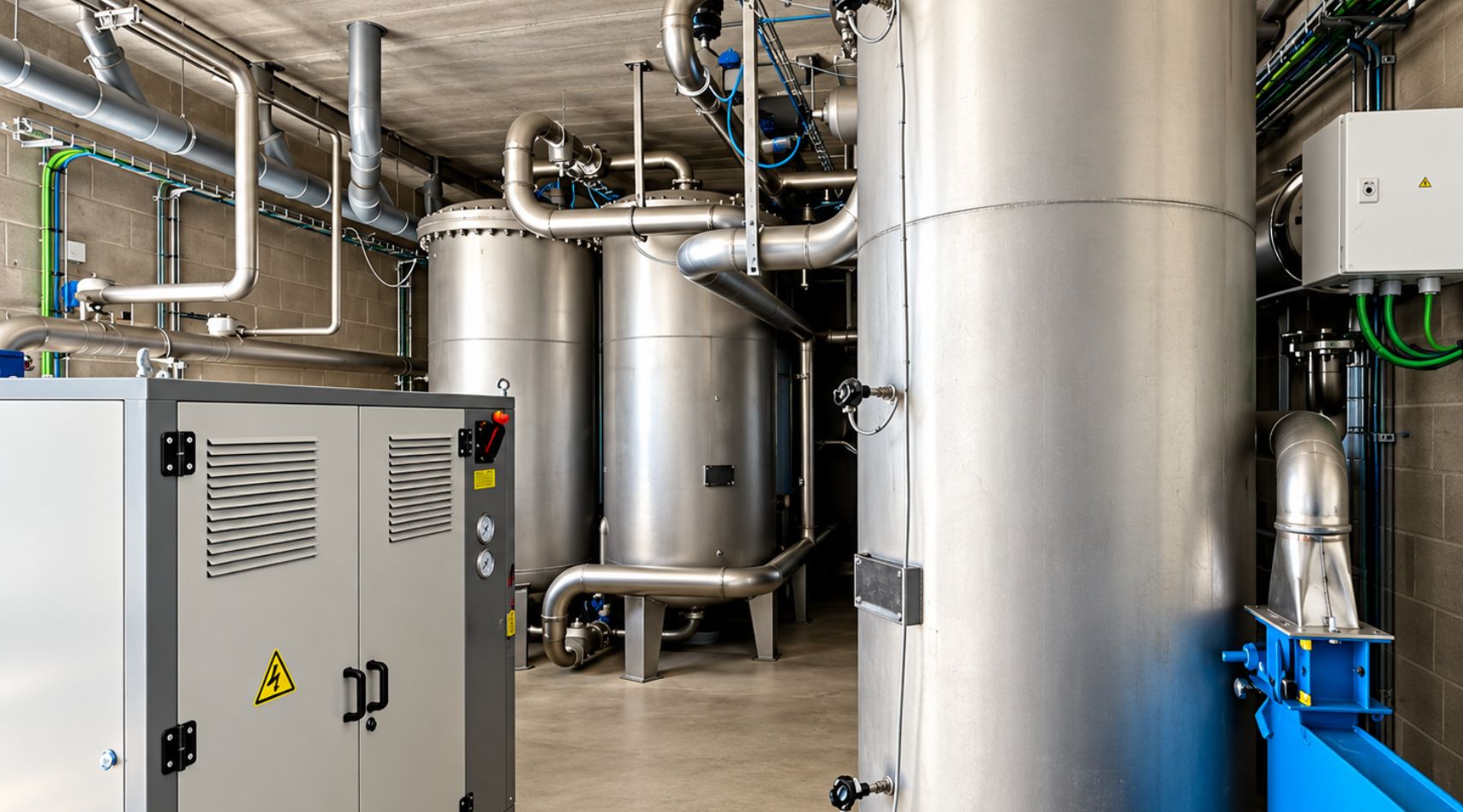
One way to strengthen this autonomy is to produce your own CO₂ from boiler flue gases. At GasN2, CO₂ capture and purification is part of our innovation work aimed at turning industrial streams into usable resources.
In plants with a suitable source, boiler flue gases can be treated to recover and reuse CO₂ within the production process. The specific configuration always depends on the gas source, its composition, the available flow rate and the required final quality.
How does it work, in simple terms?
- Capture of the available stream, identifying a stable source of CO₂ within the process.
- Pre-treatment and separation, removing unwanted components and concentrating the CO₂.
- Purification and conditioning, until the specifications required by the application are achieved.
- Compression and integration, adapting the gas to the plant’s operating conditions.
- Reuse within the process, reducing the need for CO₂ supplied exclusively from external sources.
What variables determine feasibility?
Before considering a recovery system, the plant’s actual operating conditions must be analysed. The most relevant variables include:
- Average and maximum CO₂ consumption and the hourly or seasonal demand profile.
- Required quality and purity according to the final application.
- Characteristics of the available source: flow rate, composition and operating hours.
- Current cost of CO₂ and energy, to assess the project’s economic impact.
- Integration with existing systems and available plant space.
For food applications, the recovered gas must also comply with the relevant quality and control requirements. Feasibility must therefore always be assessed from a technical, regulatory and economic perspective.
Real case: Reixach and on-site CO₂ reuse
This strategy has already been applied in real industrial environments. In the Reixach success story, GasN2 developed a solution to capture and concentrate the CO₂ present in boiler flue gases, treat it and feed it back into the production process.
The installation currently meets 100% of the plant’s internal CO₂ demand through on-site recovery. The project combines supply autonomy, reduced logistics dependence and the use of a stream that was not previously reused.
A development line for agri-food applications
GasN2 is also working on a pioneering CO₂ recovery and reuse facility for the agri-food sector, with the aim of treating industrial emissions and turning them into a usable resource. Projects of this kind reinforce the same idea: circularity can translate directly into greater operational resilience.
How can the plant prepare before winter?
The best time to review CO₂ supply is before an urgent need arises. An initial assessment makes it possible to quickly identify the plant’s level of exposure and the available improvement options.
- Quantify actual consumption and distinguish between average demand, peaks and seasonality.
- Identify critical processes that depend directly on CO₂.
- Review storage capacity and the current supply model.
- Analyse potential on-site CO₂ sources available within the facility.
- Assess the technical and economic feasibility of a full or partial CO₂ capture and reuse solution.
Depending on the plant’s characteristics, the solution can significantly reduce dependence on external CO₂ supply. The key is to size the strategy according to the plant’s actual needs.
More autonomy, efficiency and circularity
Europe’s energy context is a reminder that CO₂ supply is connected to external production and logistics chains. For industries that depend on it, anticipating these conditions can turn a potential vulnerability into an opportunity for improvement.
CO₂ capture and reuse makes it possible to consider a different model: use a resource available at the plant, reduce dependencies and move towards more efficient and circular processes.
At GasN2, we develop solutions tailored to the characteristics of each process. If your plant consumes CO₂ and has boilers, we can assess whether it is feasible to produce your own CO₂ from flue gases and reduce dependence on external supply.
Contact GasN2 and tell us about your plant’s requirements.