
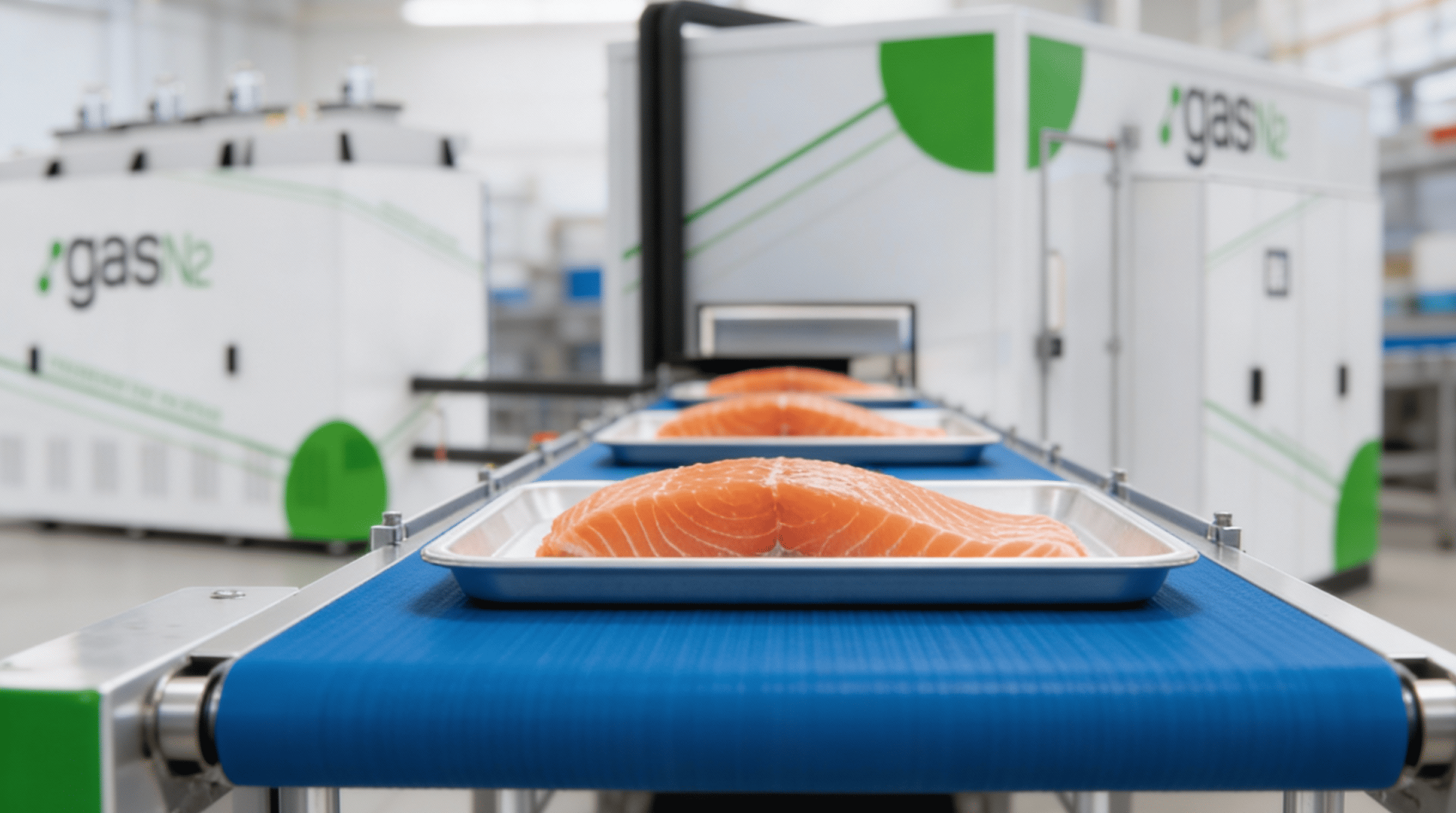
Industrial refrigeration is one of the most relevant infrastructures in the process industry. Its impact on energy consumption, operational stability and business continuity makes it a strategic asset that goes far beyond an auxiliary installation. Sectors such as food processing, chemicals, pharmaceuticals or refrigerated logistics rely on reliable refrigeration systems to ensure product quality, comply with regulations and maintain operational efficiency.
In this context, moving towards more responsible and competitive industrial models requires reviewing how refrigeration systems are conceived, sized and operated, focusing not only on their nominal capacity but on their actual performance over time. The difference between a system that “works” and one that delivers sustained value often lies in the technical decisions made during the early stages of the project.
From technical compliance to overall performance
Traditionally, many industrial refrigeration systems have been designed to meet specific requirements: achieving a certain temperature, covering maximum cooling capacity or ensuring immediate availability during peak demand. While technically correct, this approach is limited when the full life cycle of the installation is considered.
The true value of an industrial refrigeration system is measured by variables such as:
- Sustained energy consumption throughout the year, not only under design conditions.
- Operational stability across different load and production regimes.
- Ease of management for internal maintenance and operations teams.
- Ability to adapt to process changes, expansions or new regulatory requirements.
A system that is properly designed from the outset can maintain consistent performance for years. By contrast, oversized, poorly integrated systems or those designed without considering process variability tend to carry structural inefficiencies that are difficult and costly to correct later.
Design as a key performance driver
The energy and operational behaviour of a mechanical industrial refrigeration system largely depends on decisions made during the engineering phase. Equipment selection, system architecture and control logic directly determine future efficiency.
Key design factors include:
- Precise adjustment to the actual thermal load, avoiding excessive margins that penalise part-load operation.
- Analysis of process variability, considering cycles, seasonality and non-nominal operating scenarios.
- Selection of architectures that prioritise stability and control over complex solutions that are difficult to manage.
- Anticipation of future scenarios such as production increases, product changes or plant modifications.
Designing an industrial refrigeration system is not simply about adding capacity. It requires understanding how refrigeration interacts with the production process, how demand evolves over time and what level of flexibility is needed to ensure efficient and stable operation.
Integrating refrigeration into process logic
One of the most common mistakes in industrial installations is treating refrigeration as an independent system. In reality, its performance is closely linked to the process it serves.
Proper integration allows:
- Reduction of energy losses associated with unnecessary heat exchanges.
- Improved system response to load variations.
- Simplified operation and fault diagnosis.
- Extended equipment lifespan by operating under more stable conditions.
At GasN2, this approach enables the development of industrial refrigeration solutions aligned with process logic, avoiding generic designs that may be theoretically valid but penalise overall performance in practice.
Operational continuity and reliability as strategic assets
In sectors where refrigeration is critical, system reliability has a direct impact across the organisation. It is not only about avoiding downtime, but about ensuring predictable and controlled operation.
Reliability directly affects:
- Product quality, especially in temperature-sensitive processes.
- Production planning, by reducing uncertainty and last-minute adjustments.
- Costs associated with incidents, unplanned shutdowns and corrective maintenance.
- Operational safety, by minimising stressful operating conditions for equipment.
Stable, well-integrated systems with clear operating logic reduce the need for reactive interventions and allow teams to focus on higher value-added tasks.
Efficient operation throughout the life cycle
Good design is the starting point, but industrial refrigeration performance is consolidated through daily operation. Systems designed to operate efficiently at partial loads, with appropriate control strategies, maintain performance even when real conditions differ from theoretical scenarios.
This results in:
- Lower cumulative energy consumption.
- Reduced wear of critical components.
- Greater thermal stability of the process.
- Easier implementation of future improvements.
Adopting a life-cycle perspective allows technical decisions to be aligned with medium- and long-term economic and sustainability objectives.
Applied experience in real industrial environments
Experience in industrial projects shows that optimising refrigeration systems delivers tangible improvements without compromising safety or operational continuity. Common benefits include:
- Consistent and predictable containment of energy consumption.
- Improved system stability in continuous operation.
- Simplified day-to-day management by internal teams.
- Greater adaptability to changes in the production process.
These results are not achieved through isolated solutions or one-off actions. They require a technical and strategic view of the system as a whole, from design through to real operation.
Assess to improve
Industrial refrigeration optimisation begins with a rigorous assessment of the existing system and its integration into the production process. Understanding how the installation actually behaves, where demand is concentrated and what improvement potential exists is the first step towards informed decision-making.
Through the contact form, you can request a personalised assessment. A GasN2 expert will contact you to help identify improvement opportunities tailored to your installation, using a technical, realistic and results-oriented approach focused on long-term sustainability.