
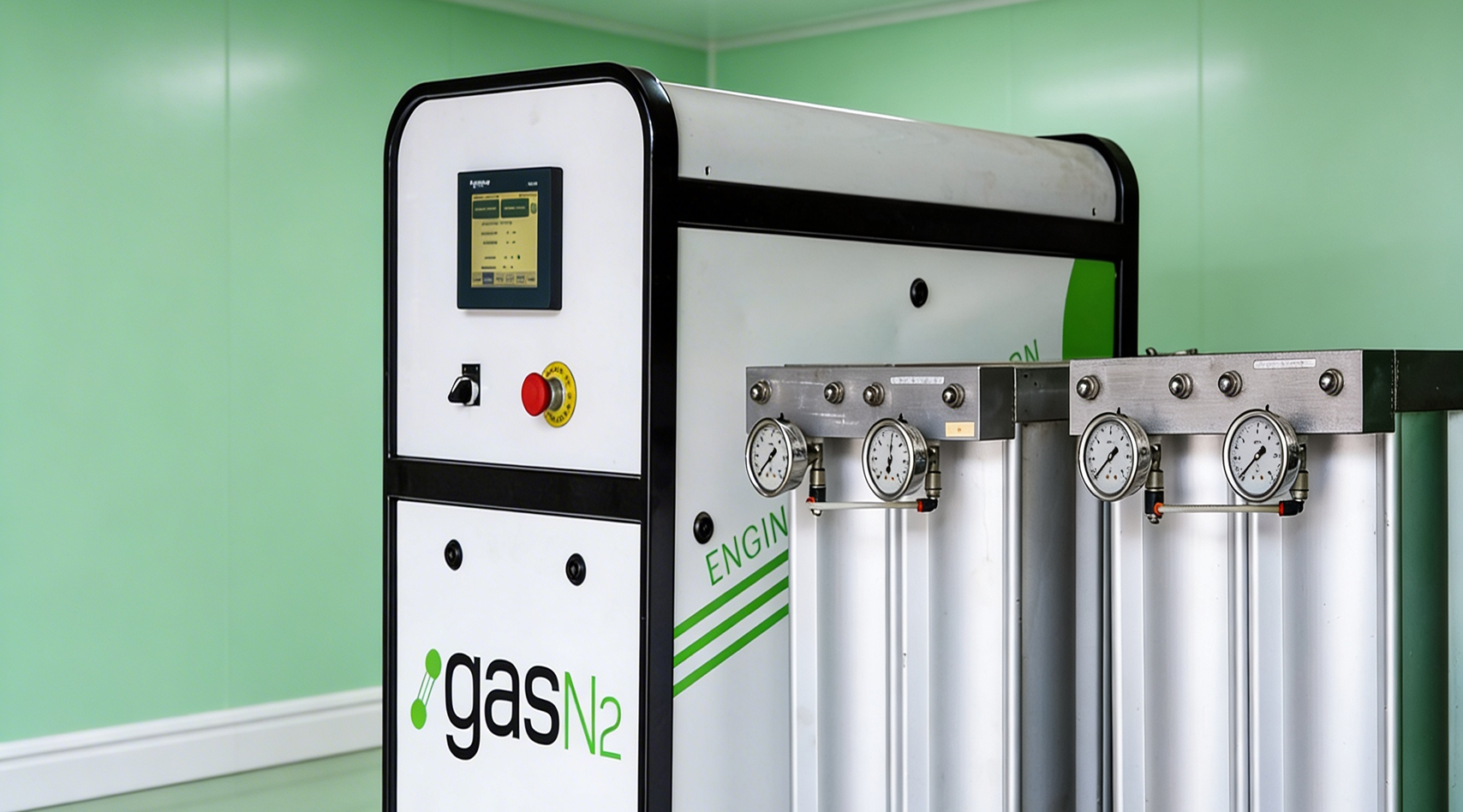
Sizing an industrial nitrogen generator is a technical decision with a direct impact on operational efficiency, energy costs and process reliability. However, one of the most common mistakes in industrial plants is selecting this type of equipment without a real analysis of nitrogen consumption or the specific operating conditions.
In many cases, sizing is based on generic estimates, occasional peak demands or the replication of existing solutions, which can lead to oversized systems —with higher investment and energy consumption— or undersized systems that compromise operational continuity.
The objective of this article is to provide a clear and practical methodology for sizing a nitrogen generation system, taking into account flow rate, purity, consumption profile and real plant requirements, and avoiding decisions based solely on catalogues or price.
Why proper sizing is critical
Correctly sizing a nitrogen generator is not simply about covering nominal demand. It is a strategic decision that affects the entire production system.
An oversized system typically involves:
- Higher initial investment (CAPEX).
- Prolonged operation at partial loads.
- Unnecessary energy consumption.
- Lower overall system efficiency.
Conversely, an undersized system can result in:
- Supply shortages at critical moments.
- Dependence on external backup sources.
- Increased operational stress on equipment.
- Risks to product quality or process safety.
There is a direct relationship between proper sizing, operational continuity, total cost and the service life of the nitrogen generation system.
Key variables for sizing a nitrogen generator
Required flow rate (Nm³/h)
Nitrogen flow rate is the first critical variable, but also one of the most frequently misunderstood.
It is essential to distinguish between:
- Actual average process consumption.
- Peak consumption associated with specific production phases.
- Simultaneous consumption at different points of use.
- Future plant growth scenarios.
Sizing based solely on maximum peak demand can lead to unnecessary oversizing. In contrast, a detailed analysis of the consumption profile allows the system to be tailored to real demand while incorporating reasonable flexibility margins.
Nitrogen purity (%)
The nitrogen purity required by the process has a direct impact on both system design and energy consumption.
Higher purity means:
- Higher energy consumption.
- Lower usable flow rate.
- Greater technological demands on the system.
For this reason, it is essential to define the purity level that is truly required, avoiding conservative specifications without technical justification.
Correctly adjusting this parameter is one of the most effective levers for optimising a nitrogen generation system.
Operating pressure
The pressure required at the point of use is often different from the generation pressure. Ignoring this aspect can lead to oversizing both the generator and the compression system.
Key considerations include:
- Actual pressure required by the process.
- Pressure losses in the distribution network.
- Network design and distances.
- The need (or not) for intermediate storage.
A well-designed system avoids generating nitrogen at pressures higher than strictly necessary.
Nitrogen usage profile in the plant
Continuous vs intermittent use
The consumption profile directly determines system architecture.
- Continuous use: favours stable systems with high efficiency and reduced storage requirements.
- Intermittent use: may require buffer tanks, modular systems or peak management strategies.
Understanding how and when nitrogen is consumed is just as important as knowing how much is consumed.
Annual operating hours
Operating hours are key to assessing:
- System profitability compared to external supply.
- Optimal equipment sizing.
- Energy efficiency strategies.
A system operating 2,000 hours per year is fundamentally different from one operating continuously for 8,000 hours per year, both economically and technically.
Existing infrastructure
Before sizing a nitrogen generation system, it is essential to analyse the infrastructure available at the plant.
Key aspects include:
- Existing compressors and their actual capacity.
- Compressed air quality (drying, filtration).
- Available installation space.
- Integration with existing networks.
- Compatibility with control and maintenance systems.
Leveraging existing infrastructure, when technically feasible, can optimise both CAPEX and implementation timelines.
Common mistakes when sizing nitrogen systems
Some of the most frequent errors in industrial projects include:
- Not considering real demand peaks.
- Ignoring future plant expansions.
- Selecting technology based solely on price.
- Failing to analyse the system’s overall energy consumption.
- Oversizing without technical justification.
Avoiding these mistakes requires a holistic view and a rigorous process analysis.
Practical sizing checklist
Before defining a nitrogen generation system, it is advisable to clearly answer the following questions:
- Required average and maximum flow rate.
- Nitrogen purity required for each application.
- Actual pressure at the point of use.
- Annual operating hours.
- Future growth margin.
- Integration with existing air and nitrogen systems.
This checklist helps ensure decisions are based on data rather than assumptions.
Correctly sizing a nitrogen generation system is a strategic plant decision, not a simple equipment choice. A rigorous analysis of consumption, purity, usage profile and existing infrastructure enables the design of more efficient, reliable systems prepared for future requirements.
Specialised technical support is key to transforming process data into solutions aligned with industrial reality, avoiding unnecessary costs and ensuring sustainable performance over time.
If you want to assess whether your current system is correctly sized or define a new one from scratch, you can request a preliminary study or a nitrogen consumption audit.