In today’s industrial environment, factors such as supply continuity, control of energy costs, and the stability of production processes are increasingly decisive. Many facilities rely on nitrogen as an essential gas to ensure safety, product quality, and operational efficiency.
Traditionally, nitrogen has been supplied through cylinders or cryogenic tanks, a model that involves logistical dependence, price variability, and less control over the process. For this reason, more and more industrial plants are opting for on-site nitrogen generation, producing the gas directly at their own facilities.
What Is an Industrial Nitrogen Generator?
An industrial nitrogen generator is a system designed to produce gaseous nitrogen directly at the point of use, separating it from ambient air through gas separation technology.
The basic principle is that atmospheric air contains approximately 78% nitrogen, 21% oxygen, and small amounts of other gases. The generator separates nitrogen from the remaining components, delivering a gas with the purity and flow rate required for the industrial process.
The main difference compared to traditional supply is that production is carried out continuously, autonomously, and on demand, eliminating the need for external transport and high-pressure gas storage.
How Does On-Site Nitrogen Generation Work?
On-site nitrogen generation uses compressed air as the raw material and processes it within the industrial facility itself to obtain nitrogen with the required specifications.
Compressed Air as the Raw Material
Air is the basis of the entire process. To ensure efficient and reliable system operation, it is essential that the compressed air has adequate quality.
This involves:
- Filtration of solid particles.
- Removal of moisture through drying systems.
- Reduction of contaminants such as oil or hydrocarbons.
Proper air preparation protects the generator and ensures consistent quality of the nitrogen produced.
Nitrogen Separation Technologies
There are different technologies for separating nitrogen from air. The most widely used in industrial applications are PSA nitrogen and membrane nitrogen, each with specific characteristics in terms of purity, flow rate, and energy consumption.
Main Nitrogen Generation Technologies
PSA Technology (Pressure Swing Adsorption)
PSA technology is based on the selective adsorption of oxygen onto an adsorbent material, typically a carbon molecular sieve.
The process operates through pressure cycles:
- Compressed air enters the system.
- Oxygen and other gases are retained by the adsorbent.
- Nitrogen passes through the system and is collected as the product.
- The material is regenerated through pressure changes.
This technology allows for high purity levels, typically ranging from 95% to over 99.999%, with flow rates adaptable to a wide range of industrial applications.
It is commonly used in industries such as food processing, metallurgy, chemical, and pharmaceutical sectors.
Membrane Technology
Membrane nitrogen generation uses polymer fibers with selective permeability to the different gases in air.
The operating principle is simple:
- Compressed air passes through the membranes.
- Oxygen, CO₂, and water vapor permeate more rapidly.
- Nitrogen is concentrated at the system outlet.
Among its main advantages are a compact design, low maintenance requirements, and rapid start-up. It is commonly used in applications with medium purity requirements and continuous processes.
Key Components of a Nitrogen Generation System
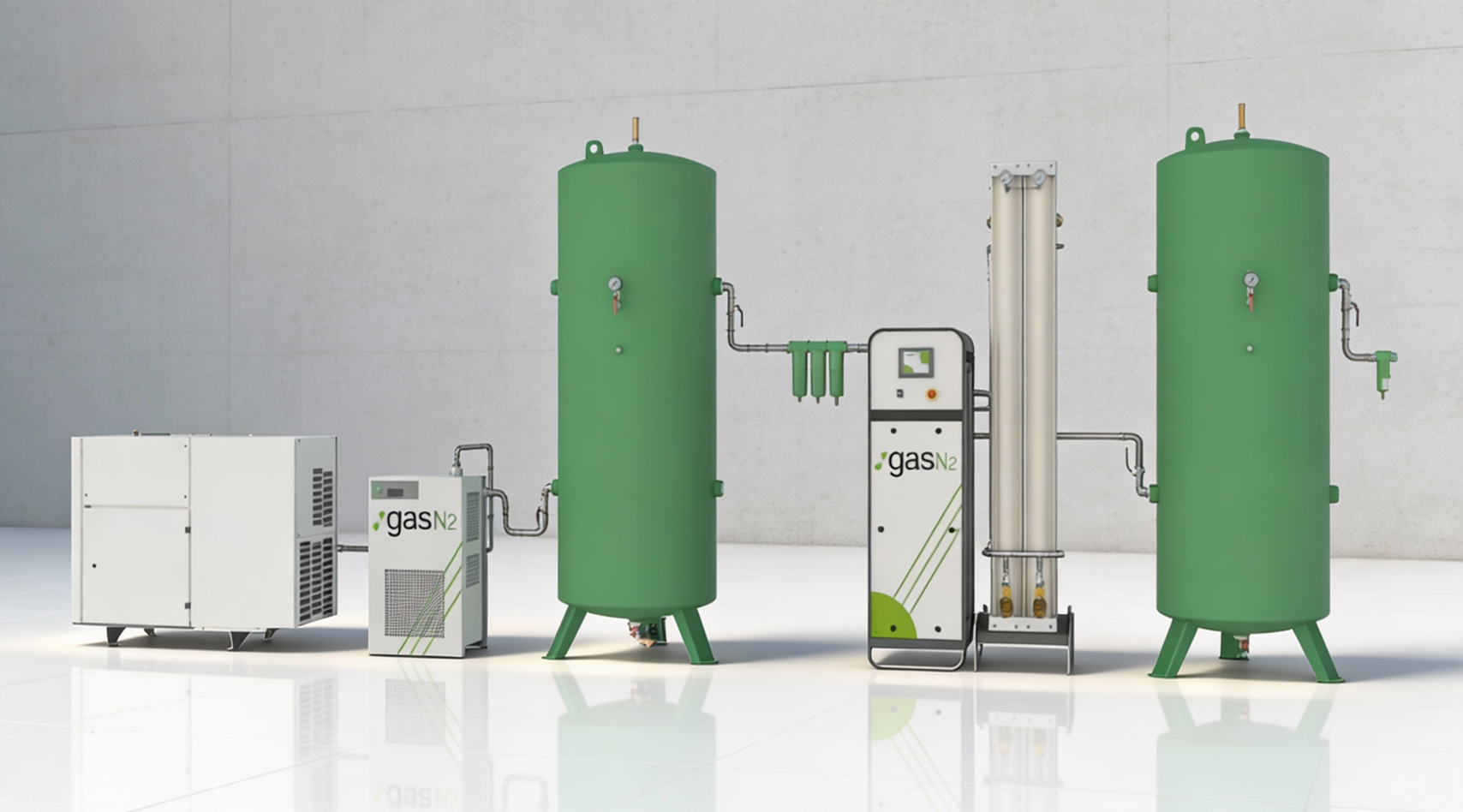
A complete industrial nitrogen generation system typically consists of:
- Air compressor, responsible for supplying compressed air.
- Air treatment system, which ensures the required air quality.
- Nitrogen generator, based on PSA or membrane technology.
- Storage tank and distribution network, to ensure pressure and flow stability.
- Control and monitoring systems, allowing supervision of purity and performance.
Proper integration of these components is essential for safe and efficient operation.
Advantages of On-Site Nitrogen Generation
Producing nitrogen directly at the plant offers clear advantages over external supply:
- Greater autonomy and supply security.
- Elimination of logistical dependence.
- Stable control of purity and pressure.
- Long-term optimization of operating costs.
- Improved energy efficiency and reduced environmental impact.
These advantages explain why on-site industrial gases are an increasingly adopted solution.
In Which Industries Is Nitrogen Generation Used?
On-site nitrogen generation is applied across numerous industrial sectors, including:
- Food industry, for packaging and preservation.
- Metallurgy, for laser cutting and inerting.
- Chemical and pharmaceutical industries, for processing and storage.
- Electronics, to protect sensitive components.
- Other industrial applications, such as automotive, plastics, paper, or energy.
The industrial nitrogen generator has become a key solution for companies seeking reliability, control, and efficiency in their processes. On-site nitrogen generation not only ensures a constant and stable supply, but also contributes to cost optimization and industrial sustainability.
To fully take advantage of these benefits, it is essential to evaluate the specific needs of each plant and select the appropriate technology and system sizing. At Gasn2, we have the experience and technical expertise to advise you at every stage, from the initial assessment to the implementation of the most suitable nitrogen generation system for your industry. Contact us and discover how we can help you optimize your processes with on-site nitrogen solutions.